
La Vera: A Different Kind of Life in Rural Spain
There are parts of rural Spain that immediately impress the visitor but are considerably more complicated when you begin to imagine actually living there. La Vera is rather different.
Stretching along the southern slopes of the Sierra de Gredos in northern Extremadura, this green corner of the province of Cáceres offers something increasingly difficult to find: genuine countryside and traditional village life without complete isolation from the rest of Spain. For someone looking for a different way of life, it deserves serious consideration.
A Surprisingly Green Spain
Anyone whose image of Extremadura is of dry plains and dehesa may be surprised by La Vera.
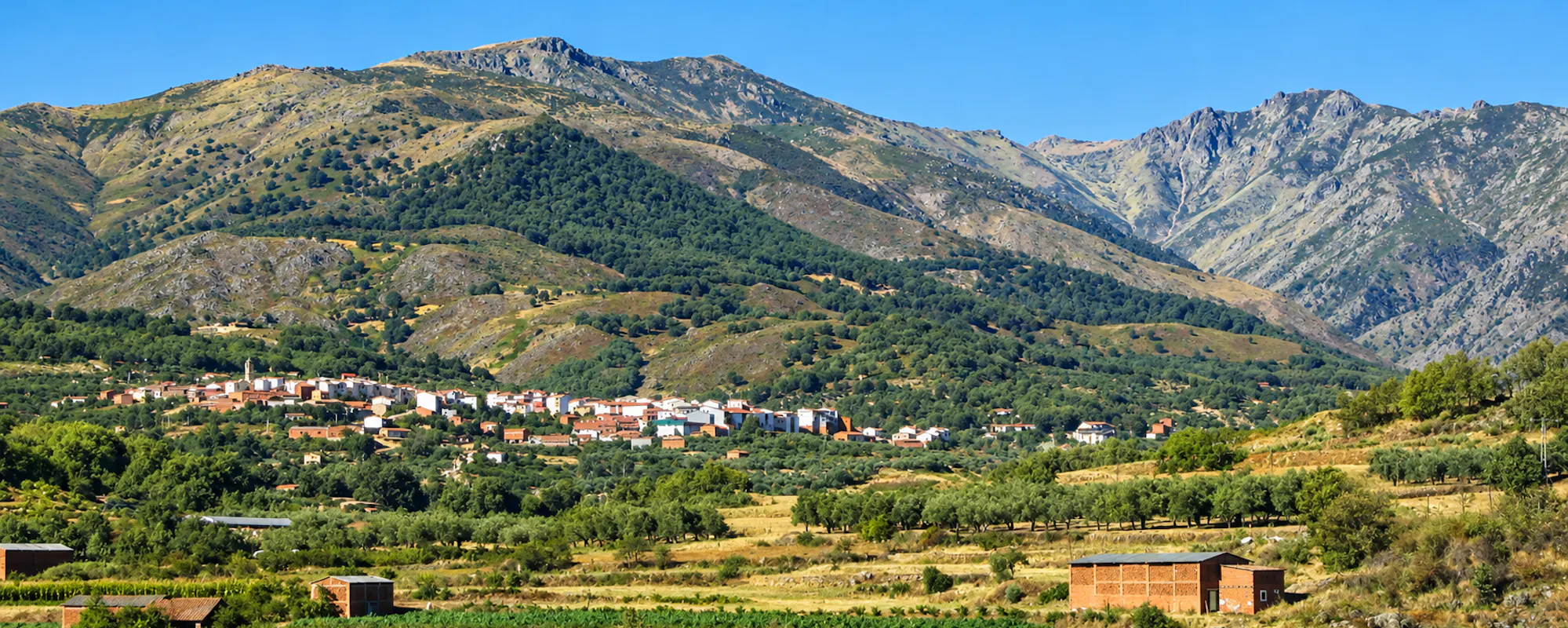
The mountains of Gredos rise immediately to the north and provide both shelter and abundant water. Streams descend from the mountains through deep gargantas, feeding natural swimming pools and producing a landscape of oak and chestnut woodland, orchards, small fields and unusually lush vegetation.
Water is one of the defining features of the area. In summer, the mountain gargantas and natural pools remain an important part of everyday life.
The landscape changes again as you descend towards the south, where the mountains give way to open country and flat land.
It means that within a comparatively small area there is an extraordinary variety of properties: village houses, old stone houses, smallholdings, equestrian properties, productive fincas and substantial country estates.
Choosing a Village
There is no single La Vera lifestyle.
Jaraíz de la Vera is the principal commercial centre and the practical choice for anyone wanting shops, supermarkets and everyday services close at hand.
Jarandilla de la Vera is another substantial village, dominated by the former castle-palace of the Counts of Oropesa, now a Parador. King Charles V stayed there while his final residence at Yuste was being prepared.
Cuacos de Yuste is inevitably associated with the Emperor and the nearby Monastery of Yuste, where Charles V spent the final years of his life.
Further east, Villanueva de la Vera and Valverde de la Vera are among the most architecturally attractive settlements in the area, with timber-framed houses, projecting balconies and narrow streets that retain much of their historic character.
Then there are considerably smaller communities such as Garganta la Olla, Losar, Madrigal, Viandar, Guijo de Santa Bárbara and Pasarón.
Five of La Vera's villages — Pasarón, Garganta la Olla, Cuacos de Yuste, Valverde and Villanueva — have particularly important protected historic centres.
The choice therefore depends upon what you are looking for. Some people want to walk to a café and buy bread every morning. Others want five hectares, no immediate neighbours and a stream running through the land. La Vera can provide both.
Rural, But Not Remote
This is one of the area's great advantages.
Madrid is sufficiently close for a journey to the capital to be practical rather than an expedition. From most of the towns and villages the drive takes only approximately two hours. That makes La Vera interesting to people who want rural life without severing their connections with Madrid altogether. Within Extremadura, Navalmoral de la Mata provides access to the A-5 corridor, while Plasencia and the provincial capital, Cáceres, provide larger-city services.
Working from La Vera
Until relatively recently, moving somewhere like La Vera usually meant finding employment locally, retiring or bringing a business with you. Remote working has changed that calculation.
Extremadura has actively tried to attract digital workers. Its programme for digital nomads offered grants of €8,000, rising to €10,000 for certain applicants, including people settling in municipalities with fewer than 5,000 inhabitants.
The regional government has continued to support remote working, recognising that bringing economically active residents into smaller communities can help counter rural depopulation.
This potentially changes the future of places like La Vera. A professional whose clients or employer are in Madrid, London, Paris or Amsterdam can increasingly live in a village in Cáceres without their income depending upon the local employment market.
A Living Agricultural Landscape
La Vera is beautiful, but it is not simply scenery. Agriculture remains visible everywhere.
The comarca is particularly famous for peppers used to produce Pimentón de la Vera, the smoked paprika carrying its own protected designation of origin. Tobacco has historically been another important crop, alongside cherries, figs, olives and other fruit. The result is a landscape that still feels worked rather than manicured.
For someone relocating from northern Europe, this can be part of the attraction. Tractors use village streets. Dogs bark. Church bells ring. Agricultural work starts early. Local fiestas can continue very late. This is not a rural theme park. It is a functioning Spanish community. That distinction matters.
Belonging
People sometimes imagine moving to rural Spain as a retreat from society. In reality, the most successful moves often involve doing precisely the opposite. Small communities notice newcomers.
Buying locally, using the village bar, learning Spanish, employing local tradespeople and simply stopping to talk to neighbours gradually changes your relationship with a place.
There are also deeply rooted local traditions. Villanueva has its extraordinary Peropalo carnival; Valverde its Empalaos during Semana Santa; Jarandilla celebrates Los Escobazos with burning bundles of broom; and the Ruta del Emperador commemorates Charles V's journey from Jarandilla to Yuste. These are not events created for tourists. They belong to the communities themselves. For foreign residents, participation in that life can become one of the unexpected pleasures of moving to rural Spain.